/
Dogodki
/
Konference
Similar yet unique
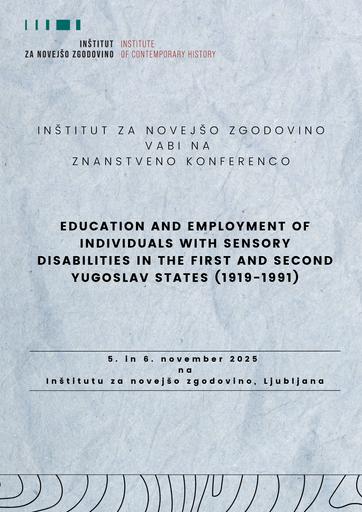
The educational experiences of people with sensory impairments in socialist Slovenia

To delo avtorja Janja Sedlaček je ponujeno pod Creative Commons Priznanje avtorstva-Nekomercialno-Deljenje pod enakimi pogoji 4.0 Mednarodna
Datoteke (1)
Opis
The presentation will explore how individuals with sensory impairments experienced education and social inclusion under socialism in Slovenia. It focuses on how they perceived their place in society, how they believed society viewed them, and how they saw themselves—placing particular emphasis on their educational trajectories. Most students with sensory impairments in socialist Slovenia attended special boarding schools for the deaf and hard-of-hearing or blind and visually impaired. A smaller number were integrated into mainstream schools, typically those who acquired their impairment later in life and whose families strongly opposed institutionalization, providing support for their inclusion in regular schools. Despite the system’s standardized structure, the educational experiences of individuals with sensory impairments varied widely. For many, formal education ended after secondary school, as the system did not foresee or encourage access to university. Nevertheless, some individuals—especially those with strong family support—managed to pursue and complete higher education. Drawing on semi-structured interviews with now-adult individuals with sensory impairments, the presentation will highlight both commonalities and differences in their educational paths. It will examine how factors such as the timing of impairment, the emotional and material support from family, and socio-economic background influenced their schooling and broader life trajectories.
Metapodatki (12)
- identifikatorhttps://hdl.handle.net/11686/71569
- naslov
- Similar yet unique
- The educational experiences of people with sensory impairments in socialist Slovenia
- avtor
- Janja Sedlaček
- soavtor
- Jelena Seferović (mod.)
- predmet
- senzorno ovirani
- izobraževanje
- socializem
- Slovenija
- opis
- The presentation will explore how individuals with sensory impairments experienced education and social inclusion under socialism in Slovenia. It focuses on how they perceived their place in society, how they believed society viewed them, and how they saw themselves—placing particular emphasis on their educational trajectories. Most students with sensory impairments in socialist Slovenia attended special boarding schools for the deaf and hard-of-hearing or blind and visually impaired. A smaller number were integrated into mainstream schools, typically those who acquired their impairment later in life and whose families strongly opposed institutionalization, providing support for their inclusion in regular schools. Despite the system’s standardized structure, the educational experiences of individuals with sensory impairments varied widely. For many, formal education ended after secondary school, as the system did not foresee or encourage access to university. Nevertheless, some individuals—especially those with strong family support—managed to pursue and complete higher education. Drawing on semi-structured interviews with now-adult individuals with sensory impairments, the presentation will highlight both commonalities and differences in their educational paths. It will examine how factors such as the timing of impairment, the emotional and material support from family, and socio-economic background influenced their schooling and broader life trajectories.
- založnik
- Inštitut za novejšo zgodovino
- datum
- 05. 11. 2025 - 06. 11. 2025
- tip
- video
- jezik
- Angleščina
- jeDelOd
- pravice
- licenca: ccByNcSa