
/
Dogodki
/
Konference
Is a history of disability in Yugoslavia possible?
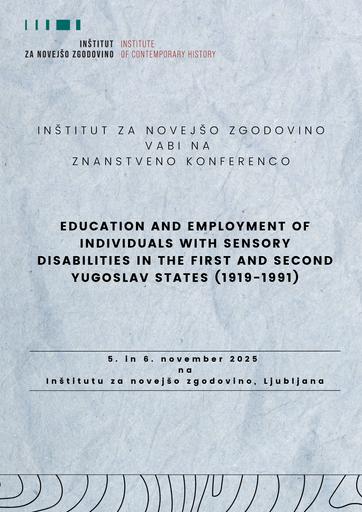

To delo avtorjev Atila Lukić, Gordan Maslov je ponujeno pod Creative Commons Priznanje avtorstva-Nekomercialno-Deljenje pod enakimi pogoji 4.0 Mednarodna
Datoteke (1)
Opis
When a civil activist Cvjetana Plavša-Matić declared in 2009 how the ratification of the Convention on the Rights of Persons with Disabilities in Croatia is a historic moment, so much so that it is a start of an “exit out of the historical silence” (2009: 3), she unwittingly made a contribution to an epistemology of disability: something fundamental has changed as a new subject came on to the historical scene. What was, from that point onwards remained strictly in the past. While we should not take this statement as the way to the truth of the history of disability in Croatia and Yugoslavia, we should take it seriously. It seems that, at least in Croatia, disability came about fairly recently. What was this before? Was there a subject of disability, a historical figure whose transformations culminated in the recognition of its human rights or was the politics of disability subsumed in other political struggles or perhaps even neglected. We propose, following the work of Michel Foucault and Gilles Deleuze, to analyze the history of the present of disability. While historical periodization as such is necessarily arbitrary, the historical period this conference focuses on is defined by the way labour came to define a way of thinking about human beings. This paper will focus not on specific policies of the historical period, but on the specific arrangement of labour in its historical context and its newly found anthropological and political role: how and by what processes has one's potentiality of labour become what one is.
Metapodatki (12)
- identifikatorhttps://hdl.handle.net/11686/71567
- naslov
- Is a history of disability in Yugoslavia possible?
- avtor
- Atila Lukić
- Gordan Maslov
- soavtor
- Jelena Seferović (mod.)
- predmet
- senzorno ovirani
- osebe s posebnimi potrebami
- Jugoslavija
- opis
- When a civil activist Cvjetana Plavša-Matić declared in 2009 how the ratification of the Convention on the Rights of Persons with Disabilities in Croatia is a historic moment, so much so that it is a start of an “exit out of the historical silence” (2009: 3), she unwittingly made a contribution to an epistemology of disability: something fundamental has changed as a new subject came on to the historical scene. What was, from that point onwards remained strictly in the past. While we should not take this statement as the way to the truth of the history of disability in Croatia and Yugoslavia, we should take it seriously. It seems that, at least in Croatia, disability came about fairly recently. What was this before? Was there a subject of disability, a historical figure whose transformations culminated in the recognition of its human rights or was the politics of disability subsumed in other political struggles or perhaps even neglected. We propose, following the work of Michel Foucault and Gilles Deleuze, to analyze the history of the present of disability. While historical periodization as such is necessarily arbitrary, the historical period this conference focuses on is defined by the way labour came to define a way of thinking about human beings. This paper will focus not on specific policies of the historical period, but on the specific arrangement of labour in its historical context and its newly found anthropological and political role: how and by what processes has one's potentiality of labour become what one is.
- založnik
- Inštitut za novejšo zgodovino
- datum
- 05. 11. 2025 - 06. 11. 2025
- tip
- video
- jezik
- Angleščina
- jeDelOd
- pravice
- licenca: ccByNcSa