/
Dogodki
/
Konference
Education of deaf children in schools for the deaf in Ljubljana and Zagreb
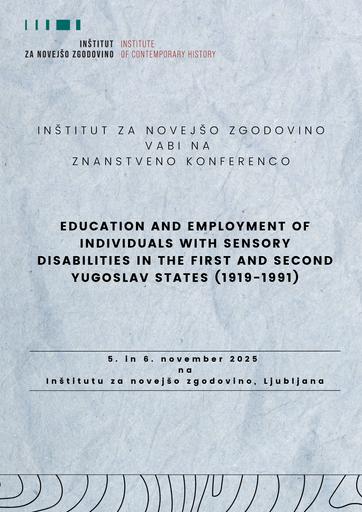

To delo avtorja Dunja Dobaja je ponujeno pod Creative Commons Priznanje avtorstva-Nekomercialno-Deljenje pod enakimi pogoji 4.0 Mednarodna
Datoteke (1)
Opis
In the interwar period, teaching was carried out according to the classical oral method, which included various teaching principles. Teachers learnt about them on professional trips abroad and in specialist literature. The article presents the teaching method according to the above-mentioned method, which schools practised from the first grade onwards, although the pupils did not yet know how to pronounce sounds and voice combinations. The aim was to raise their awareness of speech movements, lip-reading and understanding of short everyday sentences and phrases. On this basis, sign language was replaced in the upper grades in schools for the deaf. The aim was to achieve clear articulation based on the most important phonetic rules of the time, namely the law of muteness of voiced consonants and consonants at the end of words, the analogy of assimilation sounds and the so-called Winteler's law. The aim of all these articulation principles was to ensure that, on completion of their education, pupils were able to speak in such a way that they could be understood and integrated by their hearing environment. Articulation was one of the most important subjects taught. Headteachers encouraged teachers to practise speaking with their pupils at every opportunity, not only in the classroom but also on excursions, during crafts and everyday tasks. The most important prerequisite for clear articulation was correct breathing, which the teachers also paid attention to and taught the children how to breathe correctly through various exercises. Breathing exercises were also an integral part of the teaching methodology. The third important element of the teaching methodology was observation (oral reading). All these elements characterised the education of the deaf children, who were also trained in manual trades as part of their education. The most gifted had the opportunity to receive a higher education. The academic performance of the Ljubljana School for the Deaf is used as an example to analyse the effectiveness of the teaching method in terms of the number of students who progressed to higher classes and successfully completed their education. Since no archival sources are available for the school in Zagreb, the above analysis is only carried out for the institution in Ljubljana.
Metapodatki (12)
- identifikatorhttps://hdl.handle.net/11686/71556
- naslov
- Education of deaf children in schools for the deaf in Ljubljana and Zagreb
- avtor
- Dunja Dobaja
- soavtor
- Jelena Seferović (mod.)
- predmet
- izobraževanje
- otroci
- gluhi in naglušni
- Ljubljana
- Zagreb
- opis
- In the interwar period, teaching was carried out according to the classical oral method, which included various teaching principles. Teachers learnt about them on professional trips abroad and in specialist literature. The article presents the teaching method according to the above-mentioned method, which schools practised from the first grade onwards, although the pupils did not yet know how to pronounce sounds and voice combinations. The aim was to raise their awareness of speech movements, lip-reading and understanding of short everyday sentences and phrases. On this basis, sign language was replaced in the upper grades in schools for the deaf. The aim was to achieve clear articulation based on the most important phonetic rules of the time, namely the law of muteness of voiced consonants and consonants at the end of words, the analogy of assimilation sounds and the so-called Winteler's law. The aim of all these articulation principles was to ensure that, on completion of their education, pupils were able to speak in such a way that they could be understood and integrated by their hearing environment. Articulation was one of the most important subjects taught. Headteachers encouraged teachers to practise speaking with their pupils at every opportunity, not only in the classroom but also on excursions, during crafts and everyday tasks. The most important prerequisite for clear articulation was correct breathing, which the teachers also paid attention to and taught the children how to breathe correctly through various exercises. Breathing exercises were also an integral part of the teaching methodology. The third important element of the teaching methodology was observation (oral reading). All these elements characterised the education of the deaf children, who were also trained in manual trades as part of their education. The most gifted had the opportunity to receive a higher education. The academic performance of the Ljubljana School for the Deaf is used as an example to analyse the effectiveness of the teaching method in terms of the number of students who progressed to higher classes and successfully completed their education. Since no archival sources are available for the school in Zagreb, the above analysis is only carried out for the institution in Ljubljana.
- založnik
- Inštitut za novejšo zgodovino
- datum
- 05. 11. 2025 - 06. 11. 2025
- tip
- video
- jezik
- Angleščina
- jeDelOd
- pravice
- licenca: ccByNcSa