
/
Periodicals
/
Archives
Cauchy's and Močnik's Gorica as the centre of European mathematics (at the 190th anniversary of Močnik's birth)
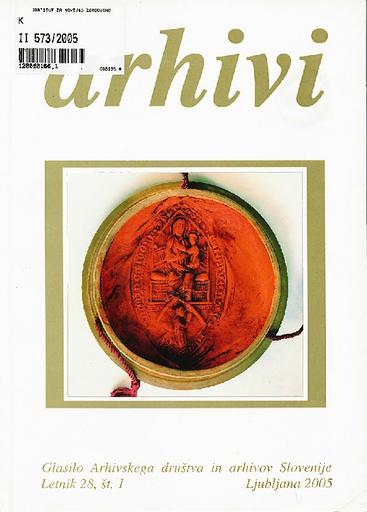
Author(s):Stanislav Južnič
Co-author(s):Matevž Košir (ur.)
Leto:2005
Publisher(s):Arhivsko društvo Slovenije, Ljubljana
Source(s):Arhivi, 2005, št. 1
Language(s):slovenščina
Type(s) of material:text
Files (1)
Name:ARHIVI_2005-1.pdf
Size:11.93MB
Format:application/pdf
Permanent link:https://hdl.handle.net/11686/file313
Description
By using French and Italian archive sources we describe Cauchy's life and work in Gorizia for the
first time in historiography. We claimed that Cauchy's close connections with Jesuits did not affect
just his political activities, but also a great deal of his scientific work. The scarce preserved Cauchy's
manuscripts help us to throw some light on the Cauchy's role at the exiled Bourbon court in Gorizia.
We find the main Cauchy's scientific collaborators in Prague, Vienna, Graz, Ljubljana, and Gorica.
In that way we present the most probable scenario of Cauchy-Mocnik collaboration on Močnik's
popularization of Cauchy's theory ofequitation and on Močnik's Ph.D. dissertation in Graz. With that
work Cauchy considerably influenced the development of Slovene mathematics.
Metadata (11)
- identifierhttps://hdl.handle.net/11686/9312
- title
- Cauchyjeva in Močnikova Gorica kot središče evropske matematike (ob 190. obletnici Močnikovega rojstva)
- Cauchy's and Močnik's Gorica as the centre of European mathematics (at the 190th anniversary of Močnik's birth)
- creator
- Stanislav Južnič
- contributor
- Matevž Košir (ur.)
- subject
- Cauchy
- Močnik
- jezuiti
- Burboni
- Gorica
- zgodovina matematičnih ved
- Cauchy
- Močnik
- Jesuits
- Bourbons
- Gorizia
- History of Mathematical Sciences
- description
- By using French and Italian archive sources we describe Cauchy's life and work in Gorizia for the first time in historiography. We claimed that Cauchy's close connections with Jesuits did not affect just his political activities, but also a great deal of his scientific work. The scarce preserved Cauchy's manuscripts help us to throw some light on the Cauchy's role at the exiled Bourbon court in Gorizia. We find the main Cauchy's scientific collaborators in Prague, Vienna, Graz, Ljubljana, and Gorica. In that way we present the most probable scenario of Cauchy-Mocnik collaboration on Močnik's popularization of Cauchy's theory ofequitation and on Močnik's Ph.D. dissertation in Graz. With that work Cauchy considerably influenced the development of Slovene mathematics.
- S pomočjo francoskih in italijanskih arhivskih virov prvič v zgodovinopisju podrobneje opisujemo delovanje Cauchyja v Gorici. Cauchy je bil eden največjih matematikov in fizikov vseh časov. Dokazujemo, da Cauchyjeva tesna povezanost z jezuiti ni opredeljevala le njegovih političnih stališč, temveč v veliki meri celo njegove znanstvene usmeritve. Ohranjeni rokopisi nam pomagajo osvetliti Cauchyjevo vlogo in položaj na izgnanem burbonskem dvoru v Gorici. Deli Cauchyjeve korespondence osvetljujejo njegova znanstvena odkritja v goriškem obdobju. Ugotavljamo, kateri so bili Cauchyjevi poglavitni sodelavci v Pragi, na Dunaju, v Gradcu, Ljubljani in Gorici. Omenjamo Cauchyjevo pomoč pri Močnikovem doktoratu; z njo je Cauchy odločilno posegel v razvoj slovenske matematike.
- publisher
- Arhivsko društvo Slovenije
- date
- 2005
- type
- besedilo
- language
- Slovenščina
- isPartOf