
/
Events
/
Conferences
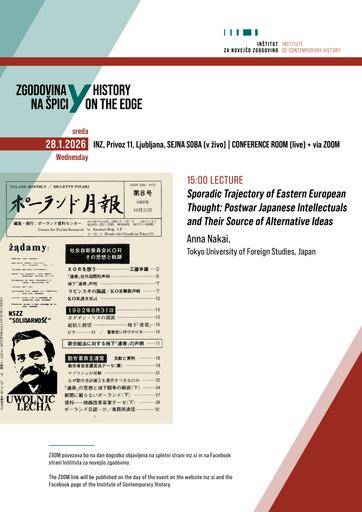
Sporadic trajectory of Eastern European thought
Postwar Japanese intellectuals and their source of alternative ideas
28. 1. 2026

This work by Anna Nakai is licensed under Creative Commons Attribution-NonCommercial-ShareAlike 4.0 International
Files (2)
Description
This presentation aims to demonstrate how intellectual productions from Eastern Europe were received in post-war Japan, not as a coherent development but as a series of irregular and discontinuous encounters. From the 1950s to the early 1990s, Japanese critics and activists approached Eastern European thought in a selective and reactive manner at key events of global upheaval.
Rather than tracing linear and direct influences, it is important to understand how these fragmented contacts influenced Japanese debates on socialism, humanism, and nationalism. How did a Hungarian communist ignite the Japanese architectural discussion? In what way did Marxist humanism impact a Japanese peace activist? Why did the Polish labor union movement become so popular during the growth of Japanese capitalism? The ideas from Eastern Europe entered Japan irregularly, providing alternatives to both Soviet orthodoxy and Japan’s own political imagination throughout the Cold War era.
The symbolic power of Eastern Europe had faded within the country by the early 1990s. The collapse of state socialism brought not clear direction but a weakening of the concept of region as meaningful frameworks for understanding. Ultimately, by connecting some dots (people) with the lines (receptions), I can emphasize how these episodic moments shaped Japan’s unique path through the global history of socialism.
Metadata (12)
- identifierhttps://hdl.handle.net/11686/71596
- title
- Sporadic trajectory of Eastern European thought
- Postwar Japanese intellectuals and their source of alternative ideas
- 28. 1. 2026
- creator
- Anna Nakai
- contributor
- Adela Hincu (mod.)
- Sergej Škofljanec (snem., ton. mojst., film. mont.)
- subject
- Japonska
- vzhodna Evropa
- intelektualci
- socializem
- komunizem
- kapitalizem
- description
- This presentation aims to demonstrate how intellectual productions from Eastern Europe were received in post-war Japan, not as a coherent development but as a series of irregular and discontinuous encounters. From the 1950s to the early 1990s, Japanese critics and activists approached Eastern European thought in a selective and reactive manner at key events of global upheaval.Rather than tracing linear and direct influences, it is important to understand how these fragmented contacts influenced Japanese debates on socialism, humanism, and nationalism. How did a Hungarian communist ignite the Japanese architectural discussion? In what way did Marxist humanism impact a Japanese peace activist? Why did the Polish labor union movement become so popular during the growth of Japanese capitalism? The ideas from Eastern Europe entered Japan irregularly, providing alternatives to both Soviet orthodoxy and Japan’s own political imagination throughout the Cold War era.The symbolic power of Eastern Europe had faded within the country by the early 1990s. The collapse of state socialism brought not clear direction but a weakening of the concept of region as meaningful frameworks for understanding. Ultimately, by connecting some dots (people) with the lines (receptions), I can emphasize how these episodic moments shaped Japan’s unique path through the global history of socialism.
- Predstavitev želi pokazati, da način, na katerega je bila intelektualna produkcija iz Vzhodne Evrope sprejeta v povojni Japonski, ni bil koherentni razvoj, ampak niz nepravilnih in prekinjenih srečanj. Od petdesetih do zgodnjih devetdesetih let so japonski kritiki in aktivisti pristopali k vzhodnoevropskemu mišljenju selektivno in reaktivno ob ključnih dogodkih globalnih pretresov.Namesto da bi sledili linearnim in neposrednim vplivom, je pomembno razumeti, kako so ti fragmentirani stiki vplivali na japonske razprave o socializmu, humanizmu in nacionalizmu. Kako je madžarski komunist sprožil japonsko arhitekturno razpravo? Na kakšen način je marksistični humanizem vplival na japonskega mirovnega aktivista? Zakaj je poljsko sindikalno gibanje postalo tako priljubljeno med rastjo japonskega kapitalizma? Ideje iz Vzhodne Evrope so vstopile v Japonsko neredno in ponujale alternative tako sovjetski ortodoksiji kot tudi japonski politični domišljiji skozi vse obdobje hladne vojne.Simbolna moč Vzhodne Evrope je v tej državi do začetka devetdesetih let prejšnjega stoletja zbledela. Razpad državnega socializma ni prinesel jasne smeri, ampak oslabitev koncepta regije kot pomembnega okvira za razumevanje. Končno, s povezovanjem nekaterih točk (ljudi) z linijami (sprejemom) lahko poudarim, kako so ti epizodni trenutki oblikovali edinstveno pot Japonske v svetovni zgodovini socializma.
- publisher
- Inštitut za novejšo zgodovino
- date
- 28. 01. 2026
- type
- video
- language
- Angleščina
- isPartOf
- rights
- license: ccByNcSa