
/
Periodicals
/
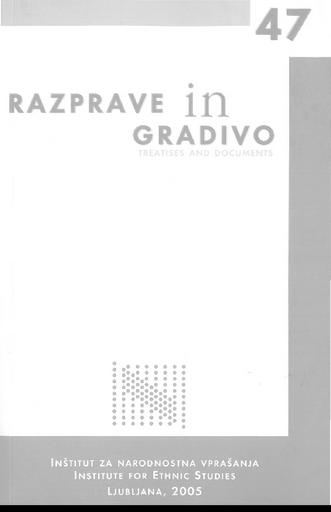
Razprave in gradivo
Extracts from slovenian "romology"
Author(s):Miran Komac
Co-author(s):Boris Jesih (odg. ur.), Mitja Žagar (gl. ur.)
Leto:2005
Publisher(s):Inštitut za narodnostna vprašanja, Ljubljana
Source(s):Razprave in gradivo, 2005, št. 47
Language(s):slovenščina
Type(s) of material:text
Files (1)
Name:Razprave_in_gradiva-47.pdf
Size:62.43MB
Format:application/pdf
Permanent link:https://hdl.handle.net/11686/file406
Description
The article highlights the attitude of the Slovene state authorities towards Roma, with special emphasis on their criminality in the first decade followingthe World War II. Roma were not acknowledged as a special ethnic community; they were treated as a foreign intruder into the Slovene national body and as a population hard to integrate into the Slovene society. All the attempts on the part of the Slovene society to solve the Roma problem (which were neither systematic nor long-term) failed to bring favourable results. Dueto instability, vagrancy, bungling and thefts Roma often found themselves persecuted by police and law courts. The biggest legal trial against Roma charged with a number of criminal offences was carried out the District Court of Maribor in 1952. A group of Roma were sentenced to yearlong imprisonment, three of them even to death. The article also deals with rather unusual relations between Roma and the majority population. It's true that Roma committed a number of thefts, but they were just a link in the trafficking chain, where profits mostly went to majority population. What's more, due to their in-born criminality, Roma were accused of criminal acts, committed by members of the majority nation. With scapegoat at hand, there is no point in wasting time and state money for in-depth investigations. The article ends with a note on sexual abuse of Roma girls.
Metadata (11)
- identifierhttps://hdl.handle.net/11686/4959
- title
- Izvlečki iz slovenske "romologije"
- Extracts from slovenian "romology"
- creator
- Miran Komac
- contributor
- Boris Jesih (odg. ur.)
- Mitja Žagar (gl. ur.)
- subject
- obdobje po drugi svetovni vojni
- Romi
- diskriminacija
- kriminogenost
- Roma
- Slovenia
- criminality
- discrimination
- description
- The article highlights the attitude of the Slovene state authorities towards Roma, with special emphasis on their criminality in the first decade followingthe World War II. Roma were not acknowledged as a special ethnic community; they were treated as a foreign intruder into the Slovene national body and as a population hard to integrate into the Slovene society. All the attempts on the part of the Slovene society to solve the Roma problem (which were neither systematic nor long-term) failed to bring favourable results. Dueto instability, vagrancy, bungling and thefts Roma often found themselves persecuted by police and law courts. The biggest legal trial against Roma charged with a number of criminal offences was carried out the District Court of Maribor in 1952. A group of Roma were sentenced to yearlong imprisonment, three of them even to death. The article also deals with rather unusual relations between Roma and the majority population. It's true that Roma committed a number of thefts, but they were just a link in the trafficking chain, where profits mostly went to majority population. What's more, due to their in-born criminality, Roma were accused of criminal acts, committed by members of the majority nation. With scapegoat at hand, there is no point in wasting time and state money for in-depth investigations. The article ends with a note on sexual abuse of Roma girls.
- Članek obravnava odnos slovenskih oblasti do romske problematike, posebej odnos do romske kriminogenosti v prvem desetletju po drugi svetovni vojni.Romi niso bili priznani kot posebna etnična skupina. Obravnavani so bili kot tujek v slovenskem nacionalnem telesu, kot populacija, ki se težko vključuje v slovensko družbo. Vsi poskusi slovenskih oblasti, da bi razrešili romski problem (resnici na ljubo velja dodati, da ti ukrepi niso bili posebej sistematični in dolgoročno zastavljeni), niso prinesli zaželenih rezultatov. Zaradi romske nestanovitnosti, potepuštva, šušmarstva in tatvin so bili pogosto predmet obravnave policije ter sodstva. Največji sodni proces proti Romom obtoženih vrste kaznivih dejanj je potekal pred okrožnim sodiščem v Mariboru leta 1952. Skupini Romov so bile izrečene visoke zaporne kazni, trijepa so bili obsojeni na smrt. Članek govori še o prav nenavadnih odnosih med romsko in večinsko populacijo. Da so Romi kradli drži. Toda bili so le člen v prekupčevalski verigi, v kateri so smetano pobirali pripadniki večinskega naroda. In ne samo to, Romom so bila zaradi "prirojene" kriminogenosti pripisana še kazniva dejanja, ki so jih povzročili pripadniki večinskega naroda. Ko imaš pri roki dežurnega krivca za vse tegobe, ki tarejo tebe in/ali tvojo okolico, res nima nobenega smisla, da bi tratil čas in državni denar za poglobljeno raziskovanje. Ob koncu prispevka je še zapis o grobem spolnem izkoriščanju romskih deklet.
- publisher
- Inštitut za narodnostna vprašanja
- date
- 2005
- type
- besedilo
- language
- Slovenščina
- isPartOf