
/
Literature
/
Monographs
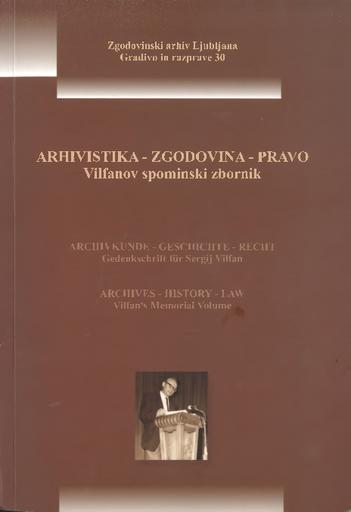
My Memories of Sergij Vilfan as Archivist Expert
Author(s):France Štukl
Co-author(s):Nataša Budna Kodrič (ur.), Tatjana Šenk (ur.), Magda Lojk (lekt.), Doris Debenjak (prev.), mag. Niko Hudelja (prev.), Katarina Kambič (prev.), Martin Cregeen (prev.), Tatjana Rodošek (foto.)
Leto:2007
Publisher(s):Zgodovinski arhiv Ljubljana, Ljubljana
Language(s):slovenščina, angleščina
Type(s) of material:text
Collection(s):Gradivo in razprave : 30
Files (1)
Name:arhivistika_zgodovina_pravo1.pdf
Size:26.99MB
Format:application/pdf
Permanent link:https://hdl.handle.net/11686/file25390
Description
Under legal provisions on the division of archive and museum activities, on the
initiative of the historian Dr. Pavle Blaznik the municipality of Škofja Loka entrusted
the custody of archives to the Municipal Archive in Ljubljana. A new position of
archivist was created in Škofja Loka, in which I was employed in September 1967.
Probation in those days lasted two years but I remained in Ljubljana, where I did
it, almost throughout the remainder of Vilfan's term of office, until 1972, working a
few day's a week in Škofija Loka. Dr. Vilfan advised me and gave probation a more
personal stamp. I did work practice in administration, in the various departments, and
in the workshop where they made fascicles and, in today's terms, primitive archive
boxes. My first independent work was Organisation of the material from the Ljubljana
earthquake of 1895. I suggested the method of Organisation myself, and Dr. Vilfan
approved it. When I was ready, we inspected the product together. He showed me
how the work could háve been done differently and better. I suggested that I should
reorganise the material but he was not in favour of this, since my way of organising it
had brought a similar result. I understood that he was always willing to seek the best
solution, which the worker should have found himself.
Disposal was a major problem for a probationer archivist, so I troubled him a lot
with this question. His wisdom was distilled into a consideration of where such
material is stored, what it teils us and to whom it is of use. He also drew my attention
to some other local, temporal and other exceptional circumstances. Only after such
considerations should material be destroyed. He advocated European Standards in
disposal, despite the socialist tendency to preserve as much material as possible.
He urged me to write articles in my basic profession, art history. He believed that
the field of research is not at all important, what matters is that the results bring new
insight and are published.
In his professional work, Dr. Vilfan strove for a careful cataloguing of material
and cross-referencing these catalogues. He showed me a photograph of a special
room in the French national archives, where bound archive catalogues are kept in
books. He was always available to me on professional questions, which gave rise to
considerable astonishment among my colleagues. He tried to get me onto a three
month course in Paris, but was unsuccessful. He involved me as a male hand in
experiments with archive equipment. Even then he was thinking of Computers. We
are doing some things now just as he imagined fořty years ago.
Let me describe some of the directions of his activity and projects at that time in
which he involved me. The most urgent was then the popularisation of archive
science. Not all archivists were of the opinion that archiving is an independent
science. Mr Jože Žontar, who was reproached with operating a new science, was a
faithful colleague on this theme. The publications »Arhivi/Archives« and »Arhivi v
Sloveniji/Archives in Slovenia« were started then. We prepared the entire material for
printing in-house at the Archive. He familiarised me with technical and editorial work
in issuing publications.
Dr. Vilfan's work outside Slovenia was important. He was well-known throughout
Europe. He used French as the language of diplomacy and correspondence. His
letters were retyped by his secretary, Mrs. Majda Kunaver. In relation to German, he
sometimes asked Mrs Traute Sežun. He talked about the particularities of foreign
cities as you or I might talk about Ljubljana. Dr. Vilfan participated in Yugoslav
Federal Symposiums less often. He was always missed there. As secretary of ADS he
often sent me to these meetings. He always wanted a report on my participation, on
which he commented.
The period of my activity in Ljubljana coincided with the period of his participation in an agrarian history project. I helped in the Organisation, in the technical Held
and in preparing the illustrative material. Before finalisation ofindividual chapters, the
team of Dr. Pavle Blaznik, Dr. Bogo Grafenauer and Dr. Sergij Vilfan withdrew into
seclusion, I think to Bled.
Let me note a few thoughts about the then atmosphere in the Archive. Dr. Vilfan
was considered a strici head by those who were afraid of him and were aware oftheir
own deficiencies. He sometimes said something about the mistake, sometimes he put
a note in the material itself and the cataloguer would find it himself later. When he
arrived at work, he normally visited each office in order to see who was doing what
and how they were progressing. He did not drive us. We could also ask for professional help during such visits. He then shut himself in his own office, where he
worked on material, did office work, dictated to his secretary and received visitors.
Dr. Pavle Blaznik was a frequent caller, Dr. Bogo Grafenauer, Dr. Josip Žontar and
other well-known scientific researchers more rarely. Mr. Jože Žontar often came
around 12 noon. That was normally a longer audience, although it was sometimes
over very quickly. Dr. Vilfan required people to whom he was talking to be up-todate on matters they were discussing. He required the same in work in the archives.
The Municipal Archive Ljubljana, sub-headed »Historical Archive of the City of
Ljubljana« was also responsible for studying the history of Ljubljana. Under the
leadership of Dr. Sergij Vilfan it published in this period several richly illustrated monographs about Ljubljana. The journal Kronika/Chronicle, which had been based
in the Municipal Archive for several years, had already left at this time, so those
working on it visited more rarely.
Dr. Vilfan was undoubtedly important in the supervision ofmy archive work, and
above all the research into which he directed me. As I said at the beginning he
expected a great deal of me and I think that I did not disappoint him. He later
encouraged me to undertake my master's degree and then doctorate, which I had
deferred because ofthe mass of archive work and other responsibilities at home.
Vilfan's departure from the Municipal Archive was sudden but not unexpected
We were not a little hurt that we were the last to know about it. He was followed by
Dr. Jože Žontar, who continued the work that had been started and moulded the
Professional and organisational image of the Archive and archive studies as an
independent science. Düring his terms of office the Historical Archive was the leader
of Slovene archive studies. Dr. Sergij Vilfan was a cosmopolitan and several decades
before his time. Even then, he conditioned promotion on knowledge, new approaches, Computers, on criteria realised by the present.
Metadata (11)
- identifierhttps://hdl.handle.net/11686/41414
- title
- Osebni pogled na Sergija Vilfana kot arhivskega strokovnjaka
- My Memories of Sergij Vilfan as Archivist Expert
- creator
- France Štukl
- contributor
- Nataša Budna Kodrič (ur.)
- Tatjana Šenk (ur.)
- Magda Lojk (lekt.)
- Doris Debenjak (prev.)
- mag. Niko Hudelja (prev.)
- Katarina Kambič (prev.)
- Martin Cregeen (prev.)
- Tatjana Rodošek (foto.)
- description
- Under legal provisions on the division of archive and museum activities, on the initiative of the historian Dr. Pavle Blaznik the municipality of Škofja Loka entrusted the custody of archives to the Municipal Archive in Ljubljana. A new position of archivist was created in Škofja Loka, in which I was employed in September 1967. Probation in those days lasted two years but I remained in Ljubljana, where I did it, almost throughout the remainder of Vilfan's term of office, until 1972, working a few day's a week in Škofija Loka. Dr. Vilfan advised me and gave probation a more personal stamp. I did work practice in administration, in the various departments, and in the workshop where they made fascicles and, in today's terms, primitive archive boxes. My first independent work was Organisation of the material from the Ljubljana earthquake of 1895. I suggested the method of Organisation myself, and Dr. Vilfan approved it. When I was ready, we inspected the product together. He showed me how the work could háve been done differently and better. I suggested that I should reorganise the material but he was not in favour of this, since my way of organising it had brought a similar result. I understood that he was always willing to seek the best solution, which the worker should have found himself. Disposal was a major problem for a probationer archivist, so I troubled him a lot with this question. His wisdom was distilled into a consideration of where such material is stored, what it teils us and to whom it is of use. He also drew my attention to some other local, temporal and other exceptional circumstances. Only after such considerations should material be destroyed. He advocated European Standards in disposal, despite the socialist tendency to preserve as much material as possible. He urged me to write articles in my basic profession, art history. He believed that the field of research is not at all important, what matters is that the results bring new insight and are published. In his professional work, Dr. Vilfan strove for a careful cataloguing of material and cross-referencing these catalogues. He showed me a photograph of a special room in the French national archives, where bound archive catalogues are kept in books. He was always available to me on professional questions, which gave rise to considerable astonishment among my colleagues. He tried to get me onto a three month course in Paris, but was unsuccessful. He involved me as a male hand in experiments with archive equipment. Even then he was thinking of Computers. We are doing some things now just as he imagined fořty years ago. Let me describe some of the directions of his activity and projects at that time in which he involved me. The most urgent was then the popularisation of archive science. Not all archivists were of the opinion that archiving is an independent science. Mr Jože Žontar, who was reproached with operating a new science, was a faithful colleague on this theme. The publications »Arhivi/Archives« and »Arhivi v Sloveniji/Archives in Slovenia« were started then. We prepared the entire material for printing in-house at the Archive. He familiarised me with technical and editorial work in issuing publications. Dr. Vilfan's work outside Slovenia was important. He was well-known throughout Europe. He used French as the language of diplomacy and correspondence. His letters were retyped by his secretary, Mrs. Majda Kunaver. In relation to German, he sometimes asked Mrs Traute Sežun. He talked about the particularities of foreign cities as you or I might talk about Ljubljana. Dr. Vilfan participated in Yugoslav Federal Symposiums less often. He was always missed there. As secretary of ADS he often sent me to these meetings. He always wanted a report on my participation, on which he commented. The period of my activity in Ljubljana coincided with the period of his participation in an agrarian history project. I helped in the Organisation, in the technical Held and in preparing the illustrative material. Before finalisation ofindividual chapters, the team of Dr. Pavle Blaznik, Dr. Bogo Grafenauer and Dr. Sergij Vilfan withdrew into seclusion, I think to Bled. Let me note a few thoughts about the then atmosphere in the Archive. Dr. Vilfan was considered a strici head by those who were afraid of him and were aware oftheir own deficiencies. He sometimes said something about the mistake, sometimes he put a note in the material itself and the cataloguer would find it himself later. When he arrived at work, he normally visited each office in order to see who was doing what and how they were progressing. He did not drive us. We could also ask for professional help during such visits. He then shut himself in his own office, where he worked on material, did office work, dictated to his secretary and received visitors. Dr. Pavle Blaznik was a frequent caller, Dr. Bogo Grafenauer, Dr. Josip Žontar and other well-known scientific researchers more rarely. Mr. Jože Žontar often came around 12 noon. That was normally a longer audience, although it was sometimes over very quickly. Dr. Vilfan required people to whom he was talking to be up-todate on matters they were discussing. He required the same in work in the archives. The Municipal Archive Ljubljana, sub-headed »Historical Archive of the City of Ljubljana« was also responsible for studying the history of Ljubljana. Under the leadership of Dr. Sergij Vilfan it published in this period several richly illustrated monographs about Ljubljana. The journal Kronika/Chronicle, which had been based in the Municipal Archive for several years, had already left at this time, so those working on it visited more rarely. Dr. Vilfan was undoubtedly important in the supervision ofmy archive work, and above all the research into which he directed me. As I said at the beginning he expected a great deal of me and I think that I did not disappoint him. He later encouraged me to undertake my master's degree and then doctorate, which I had deferred because ofthe mass of archive work and other responsibilities at home. Vilfan's departure from the Municipal Archive was sudden but not unexpected We were not a little hurt that we were the last to know about it. He was followed by Dr. Jože Žontar, who continued the work that had been started and moulded the Professional and organisational image of the Archive and archive studies as an independent science. Düring his terms of office the Historical Archive was the leader of Slovene archive studies. Dr. Sergij Vilfan was a cosmopolitan and several decades before his time. Even then, he conditioned promotion on knowledge, new approaches, Computers, on criteria realised by the present.
- publisher
- Zgodovinski arhiv Ljubljana
- collection
- Gradivo in razprave : 30
- date
- 2007
- 01. 01. 2007
- type
- besedilo
- language
- Slovenščina
- Angleščina
- isPartOf