
/
Literature
/
Monographs
The Word »Tolerance« as Legal Term
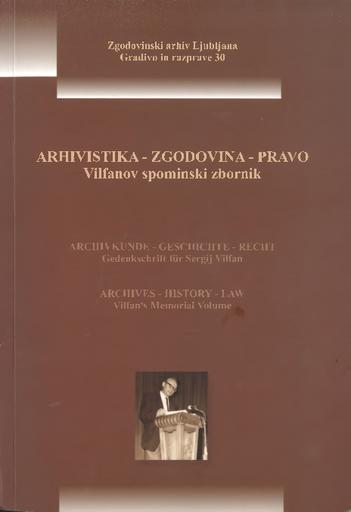
Author(s):Janez Kranjc
Co-author(s):Nataša Budna Kodrič (ur.), Tatjana Šenk (ur.), Magda Lojk (lekt.), Doris Debenjak (prev.), mag. Niko Hudelja (prev.), Katarina Kambič (prev.), Martin Cregeen (prev.), Tatjana Rodošek (foto.)
Leto:2007
Publisher(s):Zgodovinski arhiv Ljubljana, Ljubljana
Language(s):slovenščina, angleščina
Type(s) of material:text
Collection(s):Gradivo in razprave : 30
Rights:
This work by Janez Kranjc is licensed under Creative Commons Attribution-NonCommercial-NoDerivs 4.0 International
Files (1)
Name:arhivistika_zgodovina_pravo1.pdf
Size:26.99MB
Format:application/pdf
Permanent link:https://hdl.handle.net/11686/file25390
Description
As a legal term, the word tolerance came into being as religious tolerance. An apt
example is the Patent of Tolerance of the Emperor Joseph II. In October 1781
Joseph II. issued this law to eliminate restrictions placed against the practice of the
Protestant and Greek Orthodox religions. He allowed for them to hold private
Services and removed the exclusion of their members from civil Service, university
career etc. Despite this, the Roman Catholic religion remained the official rehgion and
the only one that held public Services.
Religious tolerance presupposes the existence of an official state religion. Other
religions or denominations are tolerated in a fixed legal framework. Religious freedom
thus in fact contradicts the existence ofreligious tolerance. It is giving the individuals
the freedom to believe in, practice, and promote their religion of choice without
interference or official harassment.
Despite the existence ofreligious freedom in most modem societies, the notion of
tolerance is still quite often used in legal texts. In modern legal texts, however, the
meaning ofthe word varies from čase to čase. Sometimčs it refers to a general pattern
of behaviour, while in other instances it is used to define concrete actions.
It can be said that tolerance is no more a legal term in a strict sense. It has become
much more a cultural standard of behaviour that helps interpret legal norms in the
event of conflicting interests and rights. As such, it is not conditioned by the concrete
behaviour of others.
Metadata (12)
- identifierhttps://hdl.handle.net/11686/41409
- title
- Toleranca kot pravni izraz
- The Word »Tolerance« as Legal Term
- creator
- Janez Kranjc
- contributor
- Nataša Budna Kodrič (ur.)
- Tatjana Šenk (ur.)
- Magda Lojk (lekt.)
- Doris Debenjak (prev.)
- mag. Niko Hudelja (prev.)
- Katarina Kambič (prev.)
- Martin Cregeen (prev.)
- Tatjana Rodošek (foto.)
- description
- As a legal term, the word tolerance came into being as religious tolerance. An apt example is the Patent of Tolerance of the Emperor Joseph II. In October 1781 Joseph II. issued this law to eliminate restrictions placed against the practice of the Protestant and Greek Orthodox religions. He allowed for them to hold private Services and removed the exclusion of their members from civil Service, university career etc. Despite this, the Roman Catholic religion remained the official rehgion and the only one that held public Services. Religious tolerance presupposes the existence of an official state religion. Other religions or denominations are tolerated in a fixed legal framework. Religious freedom thus in fact contradicts the existence ofreligious tolerance. It is giving the individuals the freedom to believe in, practice, and promote their religion of choice without interference or official harassment. Despite the existence ofreligious freedom in most modem societies, the notion of tolerance is still quite often used in legal texts. In modern legal texts, however, the meaning ofthe word varies from čase to čase. Sometimčs it refers to a general pattern of behaviour, while in other instances it is used to define concrete actions. It can be said that tolerance is no more a legal term in a strict sense. It has become much more a cultural standard of behaviour that helps interpret legal norms in the event of conflicting interests and rights. As such, it is not conditioned by the concrete behaviour of others.
- publisher
- Zgodovinski arhiv Ljubljana
- collection
- Gradivo in razprave : 30
- date
- 2007
- 01. 01. 2007
- type
- besedilo
- language
- Slovenščina
- Angleščina
- isPartOf
- rights
- license: ccByNcNd