/
Events
/
Conferences
Slovenian communists on the October revolution between 1920 and 1945
Author(s):Vida Deželak Barič
Co-author(s):Damijan Guštin (čl. prog. odb.), Jurij Perovšek (čl. prog. odb.), Jure Gašparič (čl. prog. odb.), Filip Čuček (čl. prog. odb.), Mojca Šorn (čl. prog. odb.)
Leto:2017
Publisher(s):Inštitut za novejšo zgodovino, Ljubljana
Source(s):Misliti o revoluciji: 100 let pozneje
Language(s):slovenščina
Type(s) of material:moving image
Rights:
This work by Vida Deželak Barič is licensed under Creative Commons Attribution-NonCommercial-NoDerivs 4.0 International
Files (2)
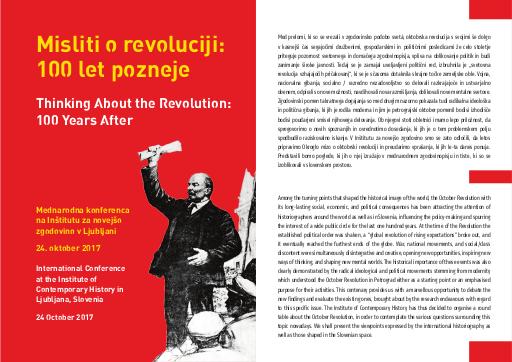
Name:vabilo.pdf
Size:1.03MB
Format:application/pdf
Permanent link:https://hdl.handle.net/11686/file23042
Description
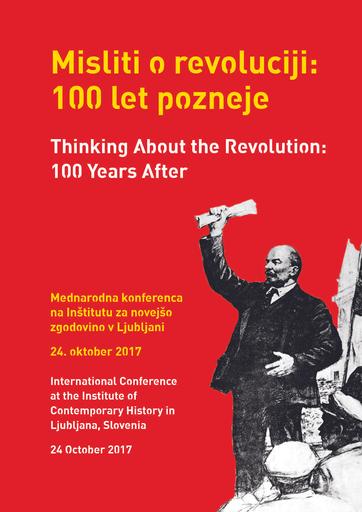
The Communist Party was established in Slovenia two and a half years after the revolutionary events in Russia in October or November 1917, and the first responses to it correspond to such a temporal distance. The Slovenian communists' opinion of the October Revolution formed completely at the second congress of the Yugoslav communists in June 1920 in Vukovar, when the Communist Party of Yugoslavia was established. The Slovenian Communist Party became an integral part of the Yugoslav Party, and a programme based on the guidelines of the Russian Bolshevik Party or the Comintern was adopted. The Vukovar Programme guided the Yugoslav and thus also Slovenian communists for the following 28 years, i.e. until the fifth congress of the Communist Party of Yugoslavia in 1948, and it, quite understandably, prescribed the attitude towards "the October". Throughout the period under consideration, the Communist Party unwaveringly maintained the ideologically-conditioned idealised image of the October Revolution, which it saw as a turning point in the human history that "liberated mankind on one sixth of the Earth's surface". It also emphasised the Bolshevik revolutionary role of Lenin and Stalin, which led to a personality cult. The attitude of the Communist Party towards the October Revolution was multifaceted. On the one hand it focused on the internal scope of the Party, while on the other hand it was aimed at the wider public space as well. The latter was anything but one-sided, as it largely depended on the extraordinary circumstances in which the Yugoslav Communist Party operated in the time of the Kingdom of SHS/Yugoslavia: i.e. on its exclusion from the public life soon after its establishment; on the specific situation during the occupation and World War II; and, throughout this time, on the tactical guidelines of the Comintern and the Soviet state leadership. Among other things, the perception of the October Revolution also became important during the celebration of its anniversaries, as well as the anniversaries of Lenin's death, establishment of the Red Army, and so on. Despite the fact that the communists concealed their revolutionary goals more or less evidently, they did not ignore the October Revolution, as they would regularly commemorate either the event itself or the measures adopted by the concurrent Soviet revolutionary authorities in order to build the socialist society as the fundamental "achievement" of the October Revolution. In this regard the Party would often act strategically, as it would, for example, publish speeches of the Soviet leaders and articles on the celebration of this occasion in the Soviet Union in the newspapers – in such a manner as to create a sort of a distance by quoting others, without directly promoting any revolutionary actions at home, even though the very publication of such texts in itself in fact attested to the Party's identification with the legacy of the October Revolution or with the social system based on it. However, on the other hand the Party would often emphasise clearly that the Soviet Union was the "true homeland" of the entire international proletariat, hence also of the Yugoslav workers. According to the Party, the land of "the October" was a model, a signpost and inspiration for all Communist Parties, the working people, and the whole of humankind in the capitalist countries. The Party also expressed its belief in a global revolution, which is why all the Communist Parties were obliged to defend the Soviet Union as the "fortress" of the international proletarian revolution in light of the imperialist threat. Throughout this time an emphasis was placed on defending the policies and orientations of the Bolshevik Party and the Comintern. The communists based the importance of the October Revolution on the concurrent grounds, and the anniversaries were an especially unique opportunity to present the achievements of the Soviet society in the economic, social, cultural, scientific, and other areas. They would repeatedly demonstrate the constant progress of the Soviet society, allegedly free of any crises in comparison with the capitalist countries, and saw the socialist system as the only possible future. During World War II, these emphases were also supplemented with the importance of the combat effectiveness of the Red Army in its struggle against fascism. In the context of the occupied Europe and the liberation aspirations, emphasising the battle readiness and the leading role in the military campaign against the Axis Powers shifted the importance of the Revolution quite automatically to the military and liberation aspects and allowed the Slovenian communists to push the ideological and political questions on what was possibly a Bolshevik basis into the background, although the year 1942 was somewhat of an exception.
Metadata (12)
- identifierhttps://hdl.handle.net/11686/38139
- title
- Slovensko komunistično gibanje in Oktobrska revolucija 1920–1945
- Slovenian communists on the October revolution between 1920 and 1945
- creator
- Vida Deželak Barič
- contributor
- Damijan Guštin (čl. prog. odb.)
- Jurij Perovšek (čl. prog. odb.)
- Jure Gašparič (čl. prog. odb.)
- Filip Čuček (čl. prog. odb.)
- Mojca Šorn (čl. prog. odb.)
- subject
- oktobrska revolucija
- October revolution
- description
- Komunistična stranka je bila na Slovenskem ustanovljena dve leti in pol po revolucionarnih oktobrskih oziroma novembrskih dogodkih leta 1917 v Rusiji in tej časovni razdalji so tudi ustrezni njeni prvi odzivi nanje. Stališče slovenskih komunistov do oktobrske revolucije se je povsem določno izoblikovalo na drugem kongresu jugoslovanskih komunistov junija 1920 v Vukovarju, ko je bila ustanovljena Komunistična stranka Jugoslavije, katere sestavni del je postala tudi komunistična stranka na Slovenskem in na katerem je bil sprejet program, ki je temeljil na programu ruske boljševiške stranke oziroma Kominterne. Vukovarski program je bil jugoslovanskim in s tem slovenskim komunistom vodilo nadaljnjih 28 let, tj. do petega kongresa KPJ leta 1948 in je razumljivo določal odnos do "Oktobra". V obravnavanem obdobju je komunistična stranka ves čas neomajno vzdrževala ideološko pogojeno idealizirano podobo oktobrske revolucije, ki jo je smatrala za prelom v človeški zgodovini, ki je "odrešil človeštvo na eni šestini zemeljske površine" ter poudarjeno izpostavljala boljševiško revolucionarno vlogo Lenina ter Stalina, kar je vodilo v kult osebnosti. Odnos komunistične stranke do oktobrske revolucije je bil večplasten. Na eni strani se je gibal v notranjem strankarskem obsegu, na drugi pa v širšem javnem prostoru. Slednji je bil vse prej kot enoznačen, saj je bil v veliki meri pogojen z izrednimi razmerami, v katerih je v času Kraljevine SHS/Jugoslavije delovala jugoslovanska komunistična stranka, torej z njeno izločitvijo iz javnega življenja kmalu po njeni ustanovitvi, s specifičnimi razmerami v času okupacije med drugo svetovno vojno, vseskozi pa s taktičnimi usmeritvami Kominterne in sovjetskega državnega vodstva. Percepcija oktobrske revolucije je med drugim jasno prihajala do izraza ob obeleževanju njenih obletnic pa tudi obletnic Leninove smrti, ustanovitve Rdeče armade itd. Kljub bolj ali manj očitnemu prikrivanju revolucionarnih ciljev komunisti niso zamolčevali oktobrske revolucije, saj so se redno spominjali samega dogodka in ukrepov, ki jih je takrat sprejela sovjetska revolucionarna oblast in so vodili v izgradnjo socialistične družbe kot temeljne "pridobitve" oktobrske revolucije. Pri tem je stranka večkrat ravnala taktično, ko je npr. v časopisju objavljala govore sovjetskih voditeljev in članke o proslavljanju praznika v Sovjetski zvezi tako, da je z govorom skozi druga usta bila ustvarjena nekakšna distanca brez neposrednega propagiranja revolucionarne akcije na domačih tleh, čeprav je seveda že sama objava takih zapisov dejansko govorila o identifikaciji z izročilom oktobrske revolucije oziroma na njej utemeljenem družbenem sistemu. Toda na drugi strani so večkrat razločno poudarjali, da je Sovjetska zveza "prava domovina" celotnega mednarodnega proletariata, torej tudi jugoslovanskega. Dežela "Oktobra" je bila v njihovem pogledu vzor, kažipot in navdih komunističnim strankam, delovnemu ljudstvu in celotnemu človeštvu v kapitalističnih deželah. Ob tem so izražali vero v svetovno revolucijo, zato so bile komunistične stranke zavezane braniti Sovjetsko zvezo kot "trdnjavo" mednarodne proletarske revolucije v primeru imperialistične ogroženosti. Vseskozi je do izraza prihajala obramba politike in usmeritev boljševiške partije in Kominterne. Komunisti so pomen oktobrske revolucije utemeljevali na aktualizirani osnovi in zlasti obletnice so bile edinstvena priložnost za predstavitev dosežkov sovjetske družbe na gospodarskem, socialnem, kulturnem, znanstvenem in drugih področjih. Ob tem so dokazovali nenehen napredek sovjetske družbe, ki da v nasprotju s kapitalističnimi deželami ne pozna kriz in edino socialističnemu sistemu prerokovali bodočnost. Tem poudarkom se je med drugo svetovno vojno pridružil pomen bojnega učinka Rdeče armade v protifašističnem nastopu. Poudarjanje bojne udarnosti in prvenstva v vojaškem nastopu proti silam osi je v kontekstu okupirane Evrope in osvobodilnih gibanj težišče pomena revolucije precej samodejno preneslo na vojaško oziroma osvobodilno področje in slovenskim komunistom omogočilo ideološko politična vprašanja na morebitni boljševiški osnovi potisniti v ozadje, pri čemer predstavlja leto 1942 določeno izjemo. O vprašanjih izvedbe revolucije, o vlogi politične stranke in delavskega razreda v njej, o strategiji in taktiki so se komunisti med drugim seznanjali na podlagi študija različnih Marxovih, Leninovih in Stalinovih spisov, konec tridesetih let sta postali nepogrešljivi Stalinova Vprašanja leninizma in Kratka zgodovina Vsezvezne komunistične partije (boljševikov). Oktobrska revolucija je bila v notranjem partijskem življenju spodbuda za teoretične in akcijske razprave o tem, kdaj in na kakšen način bo revolucija v Sloveniji in Jugoslaviji izvedena. Pomembno vlogo je tu med obema vojnama imelo šolanje partijskih kadrov v Sovjetski zvezi ali pa v kaznilnici v Sremski Mitrovici, med drugo svetovno vojno pa zlasti v partijski šoli pri centralnem komiteju Komunistične partije Slovenije. V slednji je npr. Edvard Kardelj spomladi 1944 razlagal, da trenutni procesi v Jugoslaviji potekajo v okviru buržoazno demokratične revolucije, da pa partija zavzema položaje, ki ji bodo omogočili takojšen prehod v proletarsko revolucijo, pri čemer ni nujen revolucionarni prehod, temveč je za izvedbo ciljev proletarske revolucije mogoča tudi reformistična pot in da je položaj podoben položaju v Sovjetski zvezi februarja 1917, ko je tudi Lenin dopuščal možnost reformističnega preraščanja v proletarsko revolucijo.
- The Communist Party was established in Slovenia two and a half years after the revolutionary events in Russia in October or November 1917, and the first responses to it correspond to such a temporal distance. The Slovenian communists' opinion of the October Revolution formed completely at the second congress of the Yugoslav communists in June 1920 in Vukovar, when the Communist Party of Yugoslavia was established. The Slovenian Communist Party became an integral part of the Yugoslav Party, and a programme based on the guidelines of the Russian Bolshevik Party or the Comintern was adopted. The Vukovar Programme guided the Yugoslav and thus also Slovenian communists for the following 28 years, i.e. until the fifth congress of the Communist Party of Yugoslavia in 1948, and it, quite understandably, prescribed the attitude towards "the October". Throughout the period under consideration, the Communist Party unwaveringly maintained the ideologically-conditioned idealised image of the October Revolution, which it saw as a turning point in the human history that "liberated mankind on one sixth of the Earth's surface". It also emphasised the Bolshevik revolutionary role of Lenin and Stalin, which led to a personality cult. The attitude of the Communist Party towards the October Revolution was multifaceted. On the one hand it focused on the internal scope of the Party, while on the other hand it was aimed at the wider public space as well. The latter was anything but one-sided, as it largely depended on the extraordinary circumstances in which the Yugoslav Communist Party operated in the time of the Kingdom of SHS/Yugoslavia: i.e. on its exclusion from the public life soon after its establishment; on the specific situation during the occupation and World War II; and, throughout this time, on the tactical guidelines of the Comintern and the Soviet state leadership. Among other things, the perception of the October Revolution also became important during the celebration of its anniversaries, as well as the anniversaries of Lenin's death, establishment of the Red Army, and so on. Despite the fact that the communists concealed their revolutionary goals more or less evidently, they did not ignore the October Revolution, as they would regularly commemorate either the event itself or the measures adopted by the concurrent Soviet revolutionary authorities in order to build the socialist society as the fundamental "achievement" of the October Revolution. In this regard the Party would often act strategically, as it would, for example, publish speeches of the Soviet leaders and articles on the celebration of this occasion in the Soviet Union in the newspapers – in such a manner as to create a sort of a distance by quoting others, without directly promoting any revolutionary actions at home, even though the very publication of such texts in itself in fact attested to the Party's identification with the legacy of the October Revolution or with the social system based on it. However, on the other hand the Party would often emphasise clearly that the Soviet Union was the "true homeland" of the entire international proletariat, hence also of the Yugoslav workers. According to the Party, the land of "the October" was a model, a signpost and inspiration for all Communist Parties, the working people, and the whole of humankind in the capitalist countries. The Party also expressed its belief in a global revolution, which is why all the Communist Parties were obliged to defend the Soviet Union as the "fortress" of the international proletarian revolution in light of the imperialist threat. Throughout this time an emphasis was placed on defending the policies and orientations of the Bolshevik Party and the Comintern. The communists based the importance of the October Revolution on the concurrent grounds, and the anniversaries were an especially unique opportunity to present the achievements of the Soviet society in the economic, social, cultural, scientific, and other areas. They would repeatedly demonstrate the constant progress of the Soviet society, allegedly free of any crises in comparison with the capitalist countries, and saw the socialist system as the only possible future. During World War II, these emphases were also supplemented with the importance of the combat effectiveness of the Red Army in its struggle against fascism. In the context of the occupied Europe and the liberation aspirations, emphasising the battle readiness and the leading role in the military campaign against the Axis Powers shifted the importance of the Revolution quite automatically to the military and liberation aspects and allowed the Slovenian communists to push the ideological and political questions on what was possibly a Bolshevik basis into the background, although the year 1942 was somewhat of an exception.
- publisher
- Inštitut za novejšo zgodovino
- date
- 2017
- 24. 10. 2017
- type
- video
- language
- Slovenščina
- isPartOf
- rights
- license: ccByNcNd