/
Events
/
Conferences
Learning about the connections teachers had with their school environment from annual school reports

This work by Marjetka Balkovec Debevec is licensed under Creative Commons Attribution-NonCommercial-NoDerivs 4.0 International
Files (1)
Description
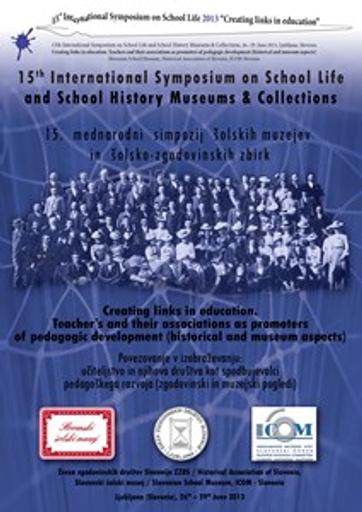
The connections teachers had with the wider environment of their school can also be studied via printed annual school reports. Some of them are kept by the Slovenian School Museum; most are from primary schools, grammar schools, and other secondary and vocational schools. The first known printed reports on the progress of pupils go back to the mid-18th century, whilst the beginnings of this custom can be found in the 16th century. Grammar schools started printing annual reports (Ger. Jahresbericht) in 1849, replacing the previous lists of students and their school results (Juventus). After 1850, primary schools in Slovenia began printing annual reports with a basic content similar to those produced by the grammar schools, whilst the publications of pedagogical and professional discussions spread after 1860 and can be followed until around 1920. Annual reports offer researchers into school history a number of important data: about how lessons were organised, about school subjects and textbooks, the language of instruction, lists of teachers and pupils, statistical data, records from school chronicles, legal provisions and regulations. We are particularly interested in the pedagogical and professional discussions among teachers published in primary school annual reports. An overview of these discussions from various Slovenian areas shows that teachers were striving particularly hard during the second half of the 19th century and early 20th century. Their efforts were directed mainly at five important areas: a great deal of attention was given to the moral education of pupils and gaining parents’ support for common educational work; another important area was patriotic education and learning about the ruling family; there were pedagogical discussions on helping the pupil’s progress; historical contributions about the history of the school and where it was located; and professional and economic discussions, which also reflect teachers’ desire to see improvements in agriculture and the economy. With the publication of discussions in annual reports teachers’ thoughts and advice, via the pupils, reached the parents and the wider social environment. The teacher can be seen as an important educator of society and standard bearer for cultural and economic progress.
Metadata (11)
- identifierhttps://hdl.handle.net/11686/37698
- title
- Learning about the connections teachers had with their school environment from annual school reports
- Povezovanje učiteljstva s šolskim okoljem preko letnih poročil šol
- creator
- Marjetka Balkovec Debevec
- subject
- zgodovina
- šolstvo
- muzej
- history
- school system
- museum
- description
- Povezovanje učiteljev in učiteljic s širšim okoljem, v katerem je šola delovala, lahko preučujemo tudi s pomočjo šolskih letnih poročil ali izvestij. Hrani jih tudi Slovenski šolski muzej, največ je osnovnošolskih, nato gimnazijskih ter drugih srednjih in strokovnih šol. Prva znana tiskana poročila o napredovanju učencev segajo v sredino 18. stoletja, začetke pa zasledimo v 16. stoletju. Gimnazije so »Jahresberichte« , slovensko Letna poročila ali Izvestja, tiskala po letu 1849 in tako zamenjala prejšnje sezname dijakov, navedene po učnem uspehu (»Iuventuse«). Letna poročila, ki so bila po osnovnih vsebinskih sklopih podobna gimnazijskim, so osnovne šole na Slovenskem začele izdajati po letu 1850, objave pedagoških in strokovnih razprav pa so se razmahnile po letu 1860 in jim sledimo do okrog leta 1920. Raziskovalcem šolske preteklosti nudijo letna poročila šol vrsto pomembnih podatkov: o organizaciji pouka, šolskih predmetih in učbenikih, jeziku poučevanja, navedeni so seznami učiteljev in učencev, statistični podatki, izpisi iz šolskih kronik, zakonska določila in uredbe. Posebej nas zanimajo pedagoške in strokovne razprave učiteljev, objavljene v osnovnošolskih letnih poročilih. Pregled teh razprav iz različnih območij slovenskega ozemlja nam prikaže prav posebno skrb učiteljskega delovanja v obdobju druge polovice 19. stoletja in v začetku 20. stoletja. Ugotavljamo, da so bila njihova prizadevanja usmerjana v glavnem na pet pomembnih področij: veliko pozornosti je bilo namenjeno vzgoji učencev in pridobivanju staršev pri skupnem vzgojnem delu; drugi pomemben sklop je predstavljala domovinska vzgoja in spoznavanje vladarske hiše, sledile so pedagoške razprave za pomoč pri napredovanju pouka, zgodovinski prispevki o zgodovini šole in kraja ter strokovno -gospodarske razprave, v katerih se kaže tudi skrb učitelja pri pospeševanju kmetijstva in gospodarstva. Z objavami razprav v letnih poročilih so razmišljanja in nasveti učiteljev preko učencev prišli do staršev in širšega družbenega okolja. Učitelja spoznamo kot pomembnega vzgojitelja družbe ter nosilca kulturnega in gospodarskega napredka.
- The connections teachers had with the wider environment of their school can also be studied via printed annual school reports. Some of them are kept by the Slovenian School Museum; most are from primary schools, grammar schools, and other secondary and vocational schools. The first known printed reports on the progress of pupils go back to the mid-18th century, whilst the beginnings of this custom can be found in the 16th century. Grammar schools started printing annual reports (Ger. Jahresbericht) in 1849, replacing the previous lists of students and their school results (Juventus). After 1850, primary schools in Slovenia began printing annual reports with a basic content similar to those produced by the grammar schools, whilst the publications of pedagogical and professional discussions spread after 1860 and can be followed until around 1920. Annual reports offer researchers into school history a number of important data: about how lessons were organised, about school subjects and textbooks, the language of instruction, lists of teachers and pupils, statistical data, records from school chronicles, legal provisions and regulations. We are particularly interested in the pedagogical and professional discussions among teachers published in primary school annual reports. An overview of these discussions from various Slovenian areas shows that teachers were striving particularly hard during the second half of the 19th century and early 20th century. Their efforts were directed mainly at five important areas: a great deal of attention was given to the moral education of pupils and gaining parents’ support for common educational work; another important area was patriotic education and learning about the ruling family; there were pedagogical discussions on helping the pupil’s progress; historical contributions about the history of the school and where it was located; and professional and economic discussions, which also reflect teachers’ desire to see improvements in agriculture and the economy. With the publication of discussions in annual reports teachers’ thoughts and advice, via the pupils, reached the parents and the wider social environment. The teacher can be seen as an important educator of society and standard bearer for cultural and economic progress.
- publisher
- Slovenski šolski muzej
- Zveza zgodovinskih društev Slovenije
- ICOM Slovenija
- Inštitut za novejšo zgodovino
- date
- 2013
- 28. 06. 2013
- type
- video
- language
- Angleščina
- isPartOf
- rights
- license: ccByNcNd