
/
Events
/
Conferences
Slovenian Teacher from Sexton, Fruit Grower and Educator to Revolutionary Soldier. Views on Professional Identity of Teachers through Time
Author(s):Branko Šuštar
Co-author(s):Irena Samide (mod.)
Leto:2016
Publisher(s):Zveza zgodovinskih društev Slovenije, Ljubljana, Inštitut za novejšo zgodovino, Ljubljana
Source(s):Podobe učiteljev in šolstva skozi čas
Language(s):slovenščina
Type(s) of material:moving image
Keywords:poklic učitelja, učiteljice, pedagoški tisk, učiteljska društva, zunajšolska dejavnost, teaching profession, teachers, pedagogical press, Teachers' Associations, extracurricular activities
Rights:
This work by Branko Šuštar is licensed under Creative Commons Attribution-NonCommercial-NoDerivs 4.0 International
Files (5)
Name:program-38-zborovanja-ZZDS.pdf
Size:313.04KB
Format:application/pdf
Permanent link:https://hdl.handle.net/11686/file22602
Name:program-38-zborovanja-ZZDS-SLO-ANG.pdf
Size:303.57KB
Format:application/pdf
Permanent link:https://hdl.handle.net/11686/file22603
Name:Knjiga-povzetkov–book-of-abstracts.pdf
Size:895.33KB
Format:application/pdf
Permanent link:https://hdl.handle.net/11686/file22604
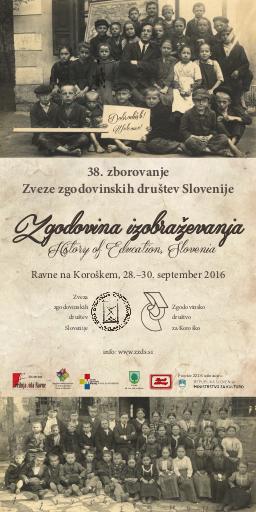
Name:Plakat-38-zborovanja-ZZDS.pdf
Size:1.36MB
Format:application/pdf
Permanent link:https://hdl.handle.net/11686/file22605
Description
The paper points to changes in the profession of an intellectual, who passes knowledge, educates and, with the participation of family and wider society, passes culture onto a younger generation. School teaching, which has been associated with church activities, and later with city and provincial government and various private initiatives, became supported by the state intensively from the mid18th century. We can follow the profession of primary school teacher and his different position from the first primary school legislation in 1774, and its changes in 19th century, when the liberal school reform from 1869 in many ways influenced the formation of modern school and the teaching profession. Male and after 1880 an increasing number of female teachers became modesty, but regularly paid provincial officials. With a higher education (four-year teacher-training colleges with matura examination) teaching also became an intellectual profession and with the end of Church school supervision at the end of the 19th century teachers became liberal-oriented. Contradictions between political Catholicism and liberalism exacerbated at school and teaching profession. Also after 1918, politicization of education was decreeing the position of teachers. In the first half of the 19th century school had an influence on the linguistic integration of Slovenians, also after 1880 it had quite an impact on the decrease of illiteracy and overall on the cultural and economic development. Teachers were important representatives of national movement, their confidence as educated national teachers was growing. They united into Teachers’ Associations and integrated into cultural and economic activities. Many a teacher was also a fruit grower, apiarist, member of a cooperative or a firefighter, a musician, a writer, a mountaineer or even a politician. Even female teachers, who have, with their professional work enabled this Pan-Slovenian cultural development, were also bearers of the women's movement. After 1945, school as a State institution educated expressly in the spirit of the new communist ideology, and the teacher was before 1990 considered as a "revolutionary soldier". In addition to the advancing professionalism of teachers also the system of ideas was equally important in school.
Metadata (12)
- identifierhttps://hdl.handle.net/11686/37466
- title
- Slovenski učitelj od mežnarja, sadjarja in pedagoga do vojaka revolucije. Pogledi na poklicne podobe učiteljev in učiteljic skozi čas
- Slovenian Teacher from Sexton, Fruit Grower and Educator to Revolutionary Soldier. Views on Professional Identity of Teachers through Time
- creator
- Branko Šuštar
- contributor
- Irena Samide (mod.)
- subject
- poklic učitelja
- učiteljice
- pedagoški tisk
- učiteljska društva
- zunajšolska dejavnost
- teaching profession
- teachers
- pedagogical press
- Teachers' Associations
- extracurricular activities
- description
- Prispevek opozarja na spremembe v poklicu izobraženca, ki posreduje znanje, ob tem vzgaja in ob sodelovanju družine in širše družbe prenaša na mlajše generacije kulturo nasploh. Za šolsko poučevanje, ki je bilo povezano s cerkveno dejavnostjo, pozneje z mestno in deželno upravo ter različnimi zasebnimi pobudami, se je država bolj intenzivno zavzemala od srede 18. stoletja. Poklicu osnovnošolskega učitelja in njegovemu različnemu položaju sledimo od prve osnovnošolske zakonodaje 1774 in njenim spremembah v 19. stoletju, ko je liberalna šolska reforma 1869 v marsičem vplivala na oblikovanje sodobne šole in učiteljskega poklica. Učitelji in po 1880 vedno številčnejše učiteljice so postali skromno, a redno plačani deželni uradniki. Z višjo izobrazbo (štiriletna učiteljišča z maturo) je tudi učiteljevanje postajalo intelektualni poklic, konec cerkvenega šolskega nadzorstva pa je do konca 19. stoletja prineslo tudi pretežno liberalno usmerjenost našega učiteljstva. Prav pri šoli in učiteljskem poklicu so se zaostrovala nasprotovanja med političnim katolicizmom in liberalizmom, politizacija šolstva pa je odrejala položaj učiteljstva tudi po 1918. Šola je v prvi polovici 19. stoletja vplivala tako na jezikovno povezovanje Slovencev, zlasti po 1880 na hitro zmanjševanje nepismenosti ter vplivala na kulturni in gospodarski razvoj. Učitelji so bili pomembni predstavniki nacionalnega gibanja, rasla je njihova stanovska samozavest kot vedno bolj izobraženih narodnih vzgojiteljev, povezovali so se v učiteljska društva in vključevali v kulturno in gospodarsko dejavnost. Marsikateri učitelj je bil še sadjar, čebelar, zadružnik ali gasilec, pa tudi glasbenik, pisatelj, planinec ali celo politik. Tudi učiteljice, ki so s poklicnim delom omogočile ta vseslovenski kulturni razvoj, so bile hkrati nosilke ženskega gibanja. Po letu 1945 je šola kot državna ustanova izrecno vzgajala v duhu nove komunistične ideologije, in učitelj je pred 1990 veljal kar za »vojaka revolucije«, pri šolskem pouku pa je bila poleg napredujoče strokovnosti učiteljev vsaj enako pomembna idejnost.
- The paper points to changes in the profession of an intellectual, who passes knowledge, educates and, with the participation of family and wider society, passes culture onto a younger generation. School teaching, which has been associated with church activities, and later with city and provincial government and various private initiatives, became supported by the state intensively from the mid18th century. We can follow the profession of primary school teacher and his different position from the first primary school legislation in 1774, and its changes in 19th century, when the liberal school reform from 1869 in many ways influenced the formation of modern school and the teaching profession. Male and after 1880 an increasing number of female teachers became modesty, but regularly paid provincial officials. With a higher education (four-year teacher-training colleges with matura examination) teaching also became an intellectual profession and with the end of Church school supervision at the end of the 19th century teachers became liberal-oriented. Contradictions between political Catholicism and liberalism exacerbated at school and teaching profession. Also after 1918, politicization of education was decreeing the position of teachers. In the first half of the 19th century school had an influence on the linguistic integration of Slovenians, also after 1880 it had quite an impact on the decrease of illiteracy and overall on the cultural and economic development. Teachers were important representatives of national movement, their confidence as educated national teachers was growing. They united into Teachers’ Associations and integrated into cultural and economic activities. Many a teacher was also a fruit grower, apiarist, member of a cooperative or a firefighter, a musician, a writer, a mountaineer or even a politician. Even female teachers, who have, with their professional work enabled this Pan-Slovenian cultural development, were also bearers of the women's movement. After 1945, school as a State institution educated expressly in the spirit of the new communist ideology, and the teacher was before 1990 considered as a "revolutionary soldier". In addition to the advancing professionalism of teachers also the system of ideas was equally important in school.
- publisher
- Zveza zgodovinskih društev Slovenije
- Inštitut za novejšo zgodovino
- date
- 2016
- 30. 09. 2016
- type
- video
- language
- Slovenščina
- isPartOf
- rights
- license: ccByNcNd