/
Events
/
Conferences
Changing River Courses as Natural Geographical Delimiting Factors in Administrative Demarcation
Co-author(s):Marko Zajc, Jernej Kosi, Zdenko Čepič, Neja Blaj Hribar
Leto:2016
Publisher(s):Inštitut za novejšo zgodovino, Ljubljana, Oddelek za zgodovino Filozofske fakultete Univerze v Ljubljani, Ljubljana
Source(s):Borders and Administrative Legacy
Language(s):angleščina
Type(s) of material:moving image
Keywords:naravne meje, geografija, spreminjanje toka, mejne reke, administrativne razmejite, natural borders, changing river courses, geography, border rivers, administrative demarcation
Rights:
This work by Mateja Breg Valjavec, Rok Ciglič, Matija Zorn is licensed under Creative Commons Attribution-NonCommercial-NoDerivs 4.0 International
Files (2)
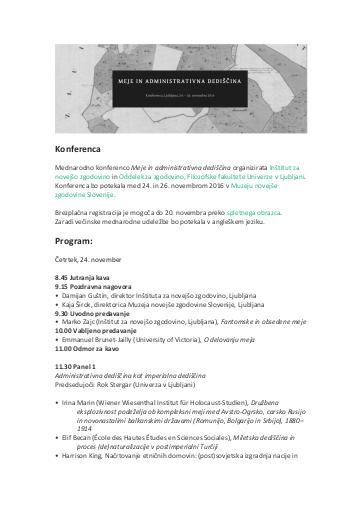
Name:Konferenca Meje.pdf
Size:1.65MB
Format:application/pdf
Permanent link:https://hdl.handle.net/11686/file22586
Description
Rivers are natural geographical dividers whose shifting courses hamper permanent administrative demarcation, especially in flat areas exposed to frequent flooding. After Slovenia’s independence in 1991, the former Yugoslav-internal (i.e., less important) border between Slovenia and Croatia became an important international border, over two-fifths of which follows rivers (the Drava, Sotla, Kolpa, Dragonja, and others).
Historical maps (the Josephinian military map and the Franciscan land register), modern cartography, and precise digital relief models were used to analyze the dynamics of changing river courses for several Slovenian border rivers that differ in their flow regime and hydrogeography, and maps were created showing the changes in these watercourses during the past two centuries.
In line with time analysis of shifting courses, limitations are highlighted for defining borders on rivers, which have their origin in natural geographical conditions that often remain overlooked in political decision-making. Even though changes in small watercourses are less distinct, under exceptional circumstances (such as flooding) their courses can also change. It is precisely because of these shifts in their courses that rivers, especially in flat areas, are not the most suitable choices for political demarcation.
Metadata (11)
- identifierhttps://hdl.handle.net/11686/37254
- title
- Changing River Courses as Natural Geographical Delimiting Factors in Administrative Demarcation
- Spreminjanje rečnega toka kot naravnogeografski omejitveni dejavnik administrativnih razmejitev
- creator
- Mateja Breg Valjavec
- Rok Ciglič
- Matija Zorn
- contributor
- Marko Zajc
- Jernej Kosi
- Zdenko Čepič
- Neja Blaj Hribar
- subject
- naravne meje
- geografija
- spreminjanje toka
- mejne reke
- administrativne razmejite
- natural borders
- changing river courses
- geography
- border rivers
- administrative demarcation
- publisher
- Inštitut za novejšo zgodovino
- Oddelek za zgodovino Filozofske fakultete Univerze v Ljubljani
- date
- 2016
- 24. 11. 2016 - 26. 11. 2016
- type
- video
- language
- Angleščina
- isPartOf
- rights
- license: ccByNcNd